 English
 Pусский
 Français
 Español
Table of Contents
- Why packing becomes a hidden bottleneck in paper cup production
- What is a paper cup packing machine?
- Manual packing vs automatic packing
- How to calculate the packing bottleneck
- When should a factory add a packing machine?
- Packing setup options by factory stage
- Common mistakes when planning cup packing
- Buyer checklist before choosing packing equipment
- FAQs
- The Bottom Line
Why Packing Becomes a Hidden Bottleneck in Paper Cup Production
A paper cup packing machine is often ignored when buyers first plan a paper cup factory. Many startup buyers focus on the paper cup machine, paper cup fan cost, cup sizes, and forming speed. These are important, but the finished cups still need to be counted, stacked, bagged, sealed, and prepared for carton delivery. If packing cannot keep up with forming, the whole line slows down.
.jpg)
The problem usually appears after orders become stable. Workers may handle packing manually at the beginning, but as cup output grows, manual counting and bagging can create delays, inconsistent quantity, higher labor cost, and messy finished goods storage. At that point, the real bottleneck is no longer the paper cup machine. The bottleneck is the packing stage.
This guide explains when a factory should add a paper cup packing machine, how to calculate the packing gap, and how different buyers can choose between manual packing, semi-automatic packing, and a more complete paper cup packing line.
What Is a Paper Cup Packing Machine?
-1602.jpg)
A paper cup packing machine is downstream equipment used after cup forming. Depending on the setup, it may count cups, stack cups, feed cups into bags, seal bags, and prepare packed cups for carton or box handling. It helps turn loose finished cups into sellable packaged units for distributors, supermarkets, food service buyers, and local wholesalers.
For buyers planning a small production line, a paper cup packing machine should not be seen as decoration. It is part of the delivery system. When it is chosen at the right time, it can reduce labor pressure, improve packed quantity consistency, and make the factory easier to scale.
| Packing Function | What It Solves | Buyer Benefit |
|---|---|---|
| Counting | Reduces quantity mistakes in each bag. | Improves customer trust and reduces complaint risk. |
| Bagging | Moves cups into packaging more consistently. | Reduces labor and keeps packing speed more stable. |
| Sealing | Closes each packed unit for storage and delivery. | Makes finished goods cleaner and easier to handle. |
| Line connection | Connects forming output with finished goods packing. | Supports more predictable delivery planning. |
Manual Packing vs Automatic Packing
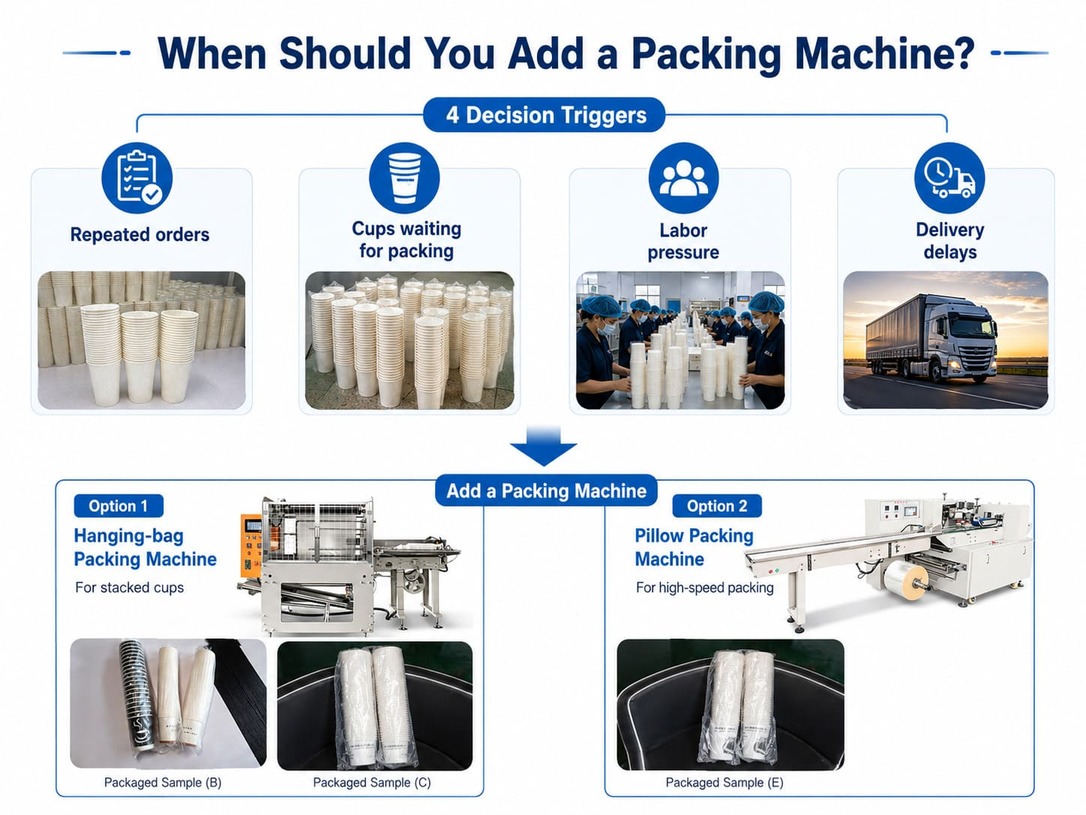
Manual packing is acceptable for small trial production, unstable early orders, and factories testing new cup sizes. Automatic packing becomes more useful when the factory has repeated orders, steady daily output, and labor pressure. The decision should be based on order stability, not only on machine price.
| Option | Best For | Main Limitation |
|---|---|---|
| Manual packing | Startup factories, sample production, low-volume orders | Labor cost and quantity mistakes increase as output grows. |
| Semi-automatic packing | Factories with growing but not fully stable orders | Still depends on worker coordination and workshop discipline. |
| Automatic paper cup packing machine | Factories with stable daily production and repeated delivery requirements | Needs suitable cup sizes, space, and a clear packing specification. |
| Paper cup packing line | Factories running multiple forming machines or large distributor orders | Requires better production planning and finished goods flow. |
Manual packing saves early investment, but automatic packing protects delivery consistency after orders become stable.
How to Calculate the Packing Bottleneck
A factory can use a simple formula before deciding whether to add packing equipment. The goal is not to calculate perfect numbers, but to see whether packing capacity is already lower than forming output.
| Question | Simple Formula | Meaning |
|---|---|---|
| Real cup output | Real Output = Forming Speed x Stable Running Time x Qualified Rate | Shows how many sellable cups enter the packing stage. |
| Packing capacity | Packing Capacity = Cups Packed Per Worker or Machine Per Hour | Shows how many cups can be prepared for delivery. |
| Packing gap | Packing Gap = Real Cup Output - Packing Capacity | If the gap is positive every day, cups will pile up. |
| Labor pressure | Packing Labor Cost = Workers x Hours x Daily Wage | Helps compare manual labor with equipment investment. |
If the packing gap appears only during occasional peak orders, better scheduling may be enough. If the gap appears in normal daily production, the factory should consider packing automation. A paper cup packing machine should be added when packing delay becomes a repeated business problem, not only an occasional busy day.
When Should a Factory Add a Packing Machine?
The best timing depends on order volume, cup size stability, worker cost, packing specification, and delivery pressure. A buyer does not need to add packing automation before the first order is clear. But waiting too long can create hidden losses.
- Add packing equipment when workers cannot keep up with normal forming output.
- Add it when customers complain about inconsistent bag quantity or poor packing appearance.
- Add it when manual packing requires too many workers during every production day.
- Add it when the factory runs repeated distributor orders with fixed packing quantities.
- Add it before adding more forming machines if packing is already the slowest stage.
-1607.jpg)
For many small factories, the correct sequence is not always "buy another paper cup machine first." If finished cups are already waiting for manual packing, adding another forming machine may increase pressure. In that case, downstream automation may create more value than another forming unit.
Packing Setup Options by Factory Stage
Packing plans should match the factory stage. A startup, a growing producer, and a mature distributor supplier need different setups.
| Factory Stage | Suggested Packing Plan | Decision Reason |
|---|---|---|
| Startup stage | Manual packing with clear counting rules | Keeps investment lower while the factory tests cup sizes and customers. |
| Growth stage | Paper cup counting machine or semi-automatic bagging support | Reduces errors and labor pressure without overbuilding the line. |
| Stable production stage | Automatic paper cup packing machine | Supports repeated orders, better delivery rhythm, and cleaner finished goods. |
| Multi-machine stage | Paper cup packing line connected with production planning | Prevents downstream handling from limiting the full production line. |
Common Mistakes When Planning Cup Packing
- Planning forming capacity without calculating packing capacity.
- Buying more paper cup machines while finished cups are already waiting for packing.
- Changing packing quantities frequently without standardizing order requirements.
- Ignoring workshop space for cup flow, packed bags, and cartons.
- Choosing packing equipment without confirming cup size range and stacking behavior.
- Treating packing as a small labor task instead of a delivery-control process.
The most expensive packing mistake is adding forming capacity while the packing stage remains unchanged. This can increase daily output on paper but reduce real delivery efficiency.
Buyer Checklist Before Choosing Packing Equipment
.jpg)
Before choosing a paper cup packing machine, buyers should prepare clear production information. This makes the equipment discussion more practical and avoids mismatched configuration.
- Confirm the main cup sizes and whether they are single wall or double wall cups.
- Confirm the target packing quantity per bag.
- Estimate daily real output from the paper cup machine or production line.
- List current packing workers, working hours, and labor cost.
- Check whether customers require printed bags, plain bags, carton packing, or special delivery units.
- Measure workshop space for cup flow from forming to packing to finished goods storage.
- Decide whether the future plan includes one paper cup machine, multiple machines, or a complete paper cup forming and packing line.
FAQs
Does every startup factory need a paper cup packing machine?
Not always. A startup can begin with manual packing if order volume is low and workers can manage counting and bagging. Packing automation becomes more useful after repeated orders and stable daily output appear.
Should I buy another paper cup machine or a packing machine first?
If forming output is already waiting for manual packing, a packing machine may be more useful than another forming machine. If packing is not yet a bottleneck, adding forming capacity may still make sense.
Can one packing machine work with multiple paper cup machines?
It may be possible depending on output, cup sizes, workshop layout, and packing rhythm. Buyers should calculate real output and packing capacity before planning a shared downstream setup.
What information should I prepare before asking for a packing machine quote?
Prepare cup size, cup height, target packing quantity, daily output, current worker cost, bag style, and workshop layout. These details help match the packing solution to the real production flow.
The Bottom Line
A paper cup packing machine should be planned as part of the whole paper cup production workflow, not as an optional accessory at the end. When packing is slower than forming, the factory may lose time, labor, delivery consistency, and customer confidence.
The best time to add packing automation is when the packing gap becomes repeated, measurable, and connected to real order delivery. For growing factories, solving the downstream bottleneck can be more profitable than simply adding more forming capacity.