 English
 Pусский
 Français
 Español
Why a Small Paper Cup Production Line Needs Careful Planning
A small paper cup production line is often the first serious investment for a startup paper cup factory, coffee cup supplier, or local packaging distributor. Many buyers start by asking for a paper cup machine price, but the real business question is wider: Can the whole workflow turn material into sellable cups with stable cost, stable quality, and stable delivery?
A forming machine is important, but it is only one part of the operation. Paper cup fan supply, printing, die cutting, forming, counting, packing, carton preparation, and finished cup delivery all affect profit. If one stage is weak, the factory may own a good machine but still lose time, labour, and orders.
This guide explains how to plan a practical small paper cup production line. It is written for buyers who want to enter the paper cup business carefully, avoid unnecessary investment, and understand when to start with a simple setup and when to add upstream or downstream equipment.
For buyers comparing a single paper cup machine with a more complete paper cup production line, the best answer is not always the largest configuration. The best answer is the setup that matches the first real orders and leaves a clear path for later expansion.
Basic Terms Buyers Should Understand First
Before comparing equipment, buyers should understand the production language. These terms appear in quotations, machine discussions, and material planning. Misunderstanding them can lead to a wrong setup.
| Term | Meaning | Why It Matters |
|---|---|---|
| Paper cup fan | The pre-cut sidewall material used to form the cup body. | It directly affects cost, printing result, forming stability, and delivery speed. |
| Bottom paper | The roll or sheet material used for the cup bottom. | It must match the sidewall material, coating, and machine setting. |
| GSM | Paper weight per square meter. | It influences cup stiffness, customer perception, and material cost. |
| Single wall cup | A common paper cup made from one cup wall. | It is usually the first product for water cups, tea cups, and many takeaway drinks. |
| Double wall cup | A cup with an extra outer sleeve or wall. | It is useful for premium coffee cups and hot drink brands. |
Buyer note: a paper cup business is not only a machine-speed business. It is a material, forming, packing, and delivery business.
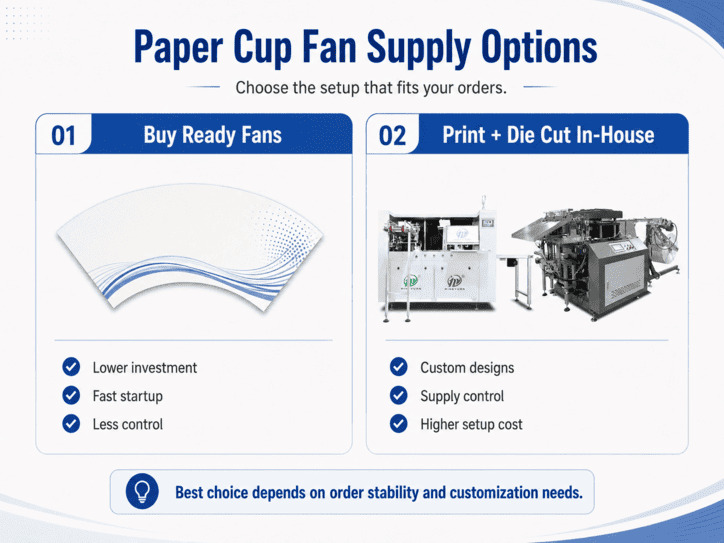
Paper cup fan supply planning helps buyers decide whether to buy ready fans first or add printing and die cutting later.
Recommended Startup Setups by Buyer Type
Different buyers need different starting points. A local distributor, a coffee cup supplier, and a factory with existing printing resources should not copy the same equipment list.
| Buyer Type | Practical First Setup | Main Reason |
|---|---|---|
| Startup paper cup factory | Paper cup machine + stable paper cup fan supplier + manual or semi-automatic packing | Keeps investment controlled while testing real demand. |
| Coffee cup supplier | Paper cup machine + printed paper cup fan plan + optional double wall cup machine | Coffee cup buyers care about branding, heat feel, and repeat orders. |
| Local packaging distributor | Forming machine + packing machine planning | Delivery consistency and packed quantity are often more important than custom printing at the beginning. |
| Custom printed cup producer | Printing + die cutting + forming workflow | Controls design changes, short lead times, and fan supply. |
The right first setup should reduce the nearest business risk, not simply include the most machines.
Simple Formulas for Output, Cost, and Packing Bottlenecks
A small line should be planned with simple numbers. Exact figures depend on cup size, machine model, material, workers, and order type, but the buyer should understand the calculation logic before buying equipment.
| Question | Simple Formula | Meaning |
|---|---|---|
| Real output | Real Output = Machine Speed × Stable Running Time × Qualified Rate | Quoted speed is not the same as sellable output. |
| Finished cup cost | Finished Cup Cost = Fan Cost + Bottom Paper + Waste + Labor + Packing + Utilities | Material price alone cannot show the real profit margin. |
| Packing bottleneck | Packing Gap = Cup Output Per Hour - Packing Capacity Per Hour | If packing is slower than forming, finished goods will pile up. |
These formulas help buyers avoid a common mistake: choosing equipment only by machine speed. A profitable small paper cup production line must balance material supply, forming speed, worker capacity, packing speed, and delivery requirements.
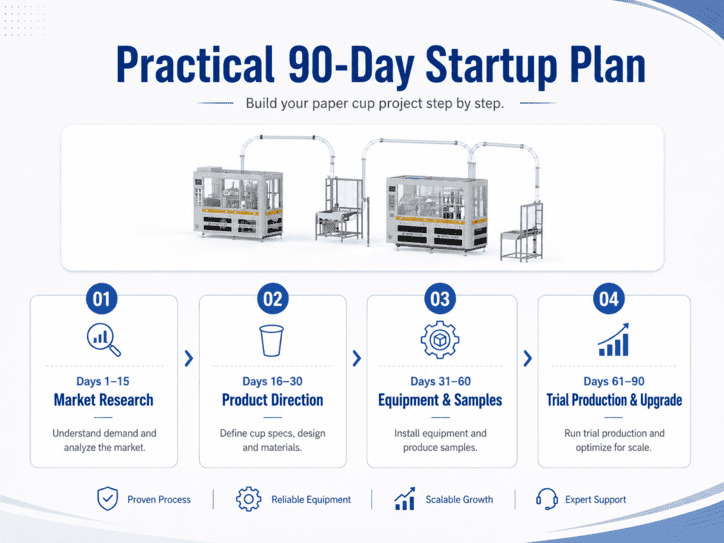
A 90-day startup plan can help buyers move from market research to samples, trial production, and gradual upgrades.
Which Equipment Should Be Bought First?
A practical startup plan can be divided into three levels: must-have, soon-needed, and later upgrade. This prevents buyers from either buying too little or buying too much too early.
| Priority | Equipment or Resource | When It Makes Sense |
|---|---|---|
| Must-have | Paper cup machine, stable fan supply, bottom paper, basic packing method | Needed to produce and deliver the first sellable cups. |
| Soon-needed | Paper cup packing machine, additional moulds, printed fan planning | Useful when orders become stable and manual work starts limiting delivery. |
| Later upgrade | Printing machine, die cutting machine, double wall cup machine, more forming machines | Better after product mix, order volume, and customer type are clear. |
A small line should be modular. The first investment should support sales today, while the layout should allow upgrades tomorrow.
Scenario Guide for Different Paper Cup Businesses
The same machine can create different business results depending on the buyer's order source. Use these scenarios to decide where the first investment should focus.
- If most orders are plain water cups: focus on forming stability, fan cost, and packing efficiency.
- If most orders are branded coffee cups: plan printed paper cup fan supply and consider double wall cup demand.
- If customers request many small designs: printing and die cutting control may become important earlier.
- If workers spend too much time counting and bagging: downstream packing equipment may create more value than adding another forming machine.
- If delivery is delayed by material preparation: the problem may be upstream fan supply, not the paper cup machine.
Common Mistakes Before Buying a Small Line
- Choosing equipment only by machine speed and ignoring real qualified output.
- Buying a forming machine without confirming paper cup fan supply.
- Ignoring packing labour until finished cups start piling up.
- Buying printing and die cutting too early when order volume is still unclear.
- Choosing cup sizes based on machine capability instead of local customer demand.
The biggest early risk is not buying a small setup. The bigger risk is buying a setup that does not match the first repeat customers.
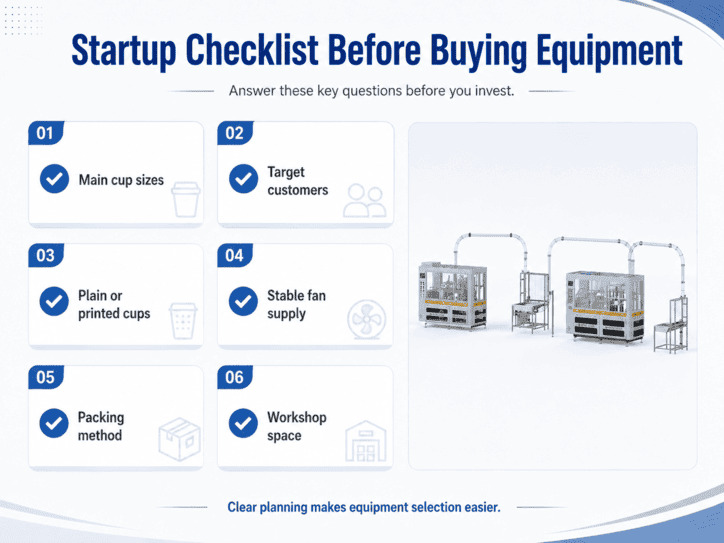
A startup checklist keeps equipment selection connected to cup sizes, target customers, fan supply, packing method, and workshop space.
Buyer Checklist Before Confirming the Order
- List the first 2-3 target cup sizes and cup applications.
- Confirm whether cups will be plain, printed, single wall, or double wall.
- Estimate monthly order volume before choosing equipment capacity.
- Check whether paper cup fan supply is ready and stable.
- Calculate real finished cup cost, not only machine price.
- Decide whether packing will be manual, semi-automatic, or automatic.
- Leave space for future printing, die cutting, packing, or additional forming machines.
FAQs
Is one paper cup machine enough to start a factory?
It can be enough if the buyer has stable paper cup fan supply, clear cup sizes, basic packing labour, and realistic first orders. However, the buyer should still plan the upstream and downstream workflow.
Should a startup buy a printing machine immediately?
Not always. If most early orders use standard or outsourced printed paper cup fans, buying printing equipment can wait. If the business depends on many custom printed designs, printing and die cutting may become important earlier.
When does a paper cup packing machine become necessary?
It becomes important when manual counting and bagging slow down delivery, increase labour costs, or create inconsistent packing quality.
What is the best small paper cup production line?
The best line is the one that matches local demand, target cup sizes, material supply, labour plan, and future upgrade path. It is not always the biggest or most expensive setup.
The Bottom Line
A small paper cup production line should be planned around customer orders, material supply, real output, labour, packing, and future upgrades. The forming machine is the centre of the line, but the complete workflow decides whether the factory can deliver profitably.
For startup buyers, the safest approach is to begin with the equipment needed for the first stable customers, keep the line modular, and add printing, die cutting, packing, or double wall equipment when the business need is clear.