 English
 Pусский
 Français
 Español
At a food packaging trade fair in early 2025, one conversation dominated the aisles: converters were struggling to keep pace with order books that looked nothing like those of three years earlier. A sales manager for a mid-sized cup producer summed it up: “Last month we ran 16 different SKUs. Three years ago, we ran four. Our mechanical cam-driven lines just can’t switch fast enough.” This sentiment is not isolated. Across the food packaging sector, the shift toward high-mix, lower-volume production is accelerating, and it is fundamentally changing what buyers demand from their forming equipment.
This article examines why full-servo technology is becoming the default choice for forward-looking converters, and what this means for anyone planning capital expenditure in 2026.
The Numbers Behind the Shift
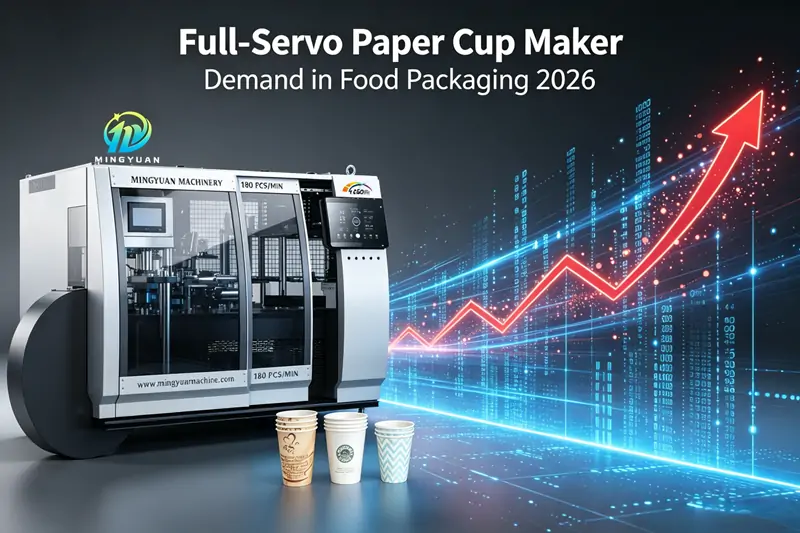
Industry data confirms the momentum. According to Mordor Intelligence, the global paper cup market was valued at approximately USD 9.2 billion in 2024 and is expected to grow at a compound annual growth rate (CAGR) of 4.5% through 2029. However, the headline number masks a bigger structural change. Growth is not coming from a uniform increase in standard 8oz and 12oz cups. Instead, it is being driven by a proliferation of custom sizes, double-wall rippled designs, and — critically — cups made from alternative barrier materials such as PLA, aqueous coatings, and high-barrier dispersions.
The European Union’s Single-Use Plastics Directive, along with similar legislation in Canada and several U.S. states, has compelled foodservice chains and CPG brands to switch to plastic-free or compostable packaging. A 2024 survey by a major packaging consultancy found that 68% of quick-service restaurant chains had active projects to eliminate PE-lined cups from their supply chains by 2027. These new material stacks are far more sensitive to processing conditions than traditional PE-coated board. A conventional paper cup machine with mechanically linked stations and limited temperature zone control often struggles to maintain a consistent seal on PLA, where the optimal sealing window can be as narrow as 5°C.
Why Full-Servo Architecture Matters
To understand the demand surge, it helps to contrast two approaches. In a traditional cam-driven cup former, a single main motor drives a central shaft, and all stations — feeding, bottom punching, heating, curling — are mechanically synchronised via gears and cams. Changing cup size means swapping cams, adjusting linkages, and fine-tuning dwell times through trial and error. For a skilled technician, a full changeover can consume three to four hours, and during that time, the machine produces nothing.
A full-servo system replaces that single mechanical drive train with independent servo motors at each key station. Cup height, bottom punch timing, sealing dwell, and curl pressure are all controlled via digital parameters. An operator selects a stored recipe on the HMI, and the machine reconfigures itself in minutes. This shift from mechanical adjustment to software-defined motion is the core reason food packaging converters are adopting servo-driven technology.
The difference is not merely about the speed of changeover. Independent servo control allows the sealing station to apply a multi-step temperature profile that gently ramps up heat for PLA, holds at the precise melting point, and then cools under controlled pressure — a profile impossible to achieve with a cam-driven dwell angle alone. For converters servicing brands that require EN 13432-certified compostable cups, this level of control translates directly into a lower leak rate and higher yield. High-precision servo cup forming equipment designed around these material requirements can reduce startup scrap by as much as 50% compared to older mechanical lines, a figure that independent productivity audits have begun to document.
How 2026’s Market Dynamics Favour Flexible Production
Several converging trends make 2026 a pivotal year. First, the private label segment is booming. Supermarket chains and coffee franchises are launching premium own-brand hot cups with seasonal designs, requiring production runs as short as 50,000 pieces. A traditional paper cup machine with a four-hour changeover cannot profitably serve a 50,000-cup order when setup represents a significant fraction of total run time. A servo line that changes over in 20 minutes can.
Second, the labour equation is changing. Skilled operators who can fine-tune cam timings are retiring, and younger technicians expect intuitive, touchscreen-driven interfaces. A full-servo system not only reduces dependence on hard-to-find mechanical expertise but also logs production parameters automatically. This data — cup count, reject rate by station, energy consumption per thousand cups — feeds directly into plant-level ERP and MES systems, supporting the traceability requirements that global food safety standards increasingly mandate.
Third, energy costs remain volatile. Servo motors draw current only when moving, and they can regenerate power during deceleration. In a high-cycling application like cup forming, a well-designed servo system can consume 20% to 30% less electricity than a continuously rotating cam-driven machine of equivalent output. Over a five-year operating horizon, this differential alone can fund a significant portion of the initial capital outlay. Advanced cup production systems with independent servo drives that incorporate regenerative braking and intelligent idle modes are starting to appear on shortlists where energy efficiency is weighted heavily in the evaluation matrix.
Real-World Material Challenges
The performance gap between servo and cam machines becomes most visible when running next-generation barrier materials. PLA-lined board, for instance, has a heat seal initiation temperature that is lower than PE but requires a very precise dwell time because its molecular structure transitions quickly from solid to melt. Overheat by a few degrees, and the polymer degrades, creating weak seams. Undershoot, and the bottom disc fails to bond.
Aqueous dispersion coatings present a different challenge. These water-based barriers require the cup bottom to be compressed and heated in a way that drives off residual moisture without blistering. A full-servo system can be programmed to apply a short, high-pressure pre-seal stage that expels moisture before the main sealing stage engages. Mechanical cam machines, with their fixed motion profiles, rarely offer this degree of staged control. Converters who have made the switch report that cup forming solutions for PLA and aqueous coatings have allowed them to confidently bid on contracts they previously had to decline — contracts that carry higher margins precisely because of the technical barrier to entry.
The 2026 Investment Checklist
For a packaging converter deciding when and how to transition to servo technology, a practical checklist can help frame the decision:
-
Product mix diversity: If more than 30% of your monthly output involves non-standard sizes or barrier materials, a servo system will likely pay back within 24 months through changeover time savings alone.
-
Run length trend: Are average order quantities shrinking? If annual average run length has decreased by 20% or more over the past two years, flexible automation is no longer optional.
-
Material roadmap: Review your key customers’ sustainability commitments. If they have publicly announced a date for eliminating PE-coated cups, you need equipment capable of running whatever replacement they adopt. A servo platform provides future-proofing.
-
Workforce profile: A machine that stores hundreds of recipes and guides the operator through setup steps reduces the training burden and the risk of human error.
-
Data integration: If your facility is moving toward ISO 22000 or BRCGS certification, the automatic parameter logging of a servo machine simplifies audits considerably.
A third paper cup machine purchase, whether it is an additional line or a replacement, represents a decision point that will shape competitiveness for the next decade. Choosing a platform that can adapt as materials, order patterns, and reporting requirements evolve is increasingly viewed as the conservative choice — not the risky one.
Looking Ahead
The trajectory is clear. As material science delivers barrier coatings with even tighter processing windows, and as brands demand ever-shorter time-to-shelf for seasonal campaigns, the flexibility of full-servo architecture moves from a nice-to-have to a baseline requirement. Forward-thinking converters are already treating their equipment not as standalone assets but as nodes in a connected production ecosystem that can be reconfigured overnight.
For those evaluating the next step, Mingyuan has invested significantly in building a range of servo-driven cup forming machinery that directly addresses these 2026-era demands. Their engineering teams have focused on modular designs that allow converters to start with a single-lane configuration and add lanes as volume grows, all controlled from a unified interface. The equipment is tested at the factory with a library of certified materials, so the commissioning curve is shorter and more predictable. Discover Mingyuan’s full-servo cup-making lineup to see how a modern, data-ready platform can fit into your production roadmap.
*Disclaimer: This article reflects industry observations and publicly available market data as of early 2025. Equipment suitability depends on specific product specifications, material characteristics, and operating conditions. Always consult with qualified engineers and conduct a site-specific evaluation before making capital equipment decisions. Market statistics are based on Mordor Intelligence, Grand View Research, and Smithers reports accessible as of the article’s writing date; readers should verify the latest figures