 English
 Pусский
 Français
 Español
Table of Contents
- When should a factory buy a paper cup printing machine?
- What role does printing play in paper cup production?
- Outsource printing or print in-house?
- How to calculate the real printing cost difference
- Order signals that justify in-house printing
- How printing connects with die cutting and forming
- Inventory and design risks buyers should control
- How sample approval protects printed cup profit
- Which buyer type should add printing first?
- Common investment mistakes
- Pre-purchase checklist
- Frequently asked questions
- The Bottom Line
When Should a Factory Buy a Paper Cup Printing Machine?
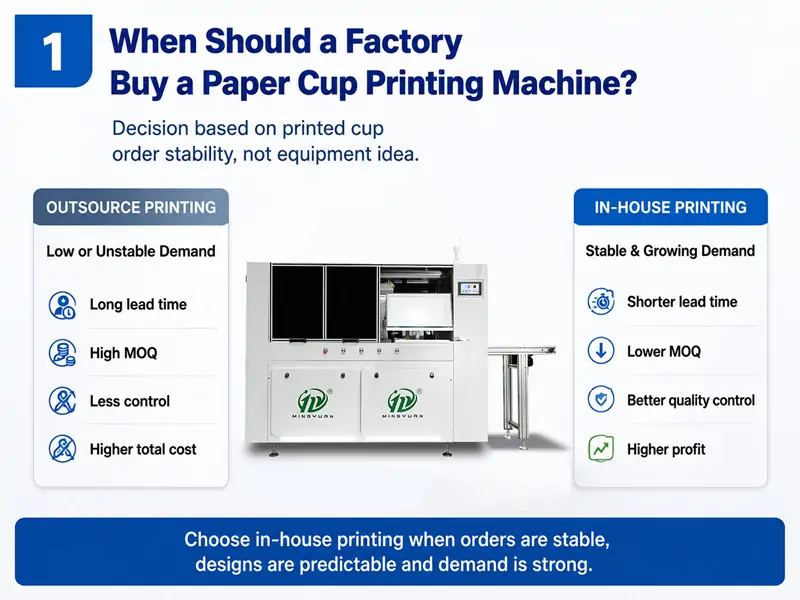
A paper cup printing machine becomes worth considering when a factory has repeated printed cup orders, predictable design demand, enough material volume, and enough operator control to keep printing quality stable. It is not always the right first purchase for a startup paper cup factory.
For many new factories, buying printed paper cup fans from an outside supplier is simpler. It reduces equipment investment, plate preparation, ink management, setup waste, quality control, and staffing pressure. In-house printing becomes more attractive when outsourced printing creates long lead times, high minimum order quantities, unstable color control, or lost custom orders.
The decision should be based on printed cup order stability, not on the idea that owning more equipment automatically creates more profit.
What Role Does Printing Play in Paper Cup Production?
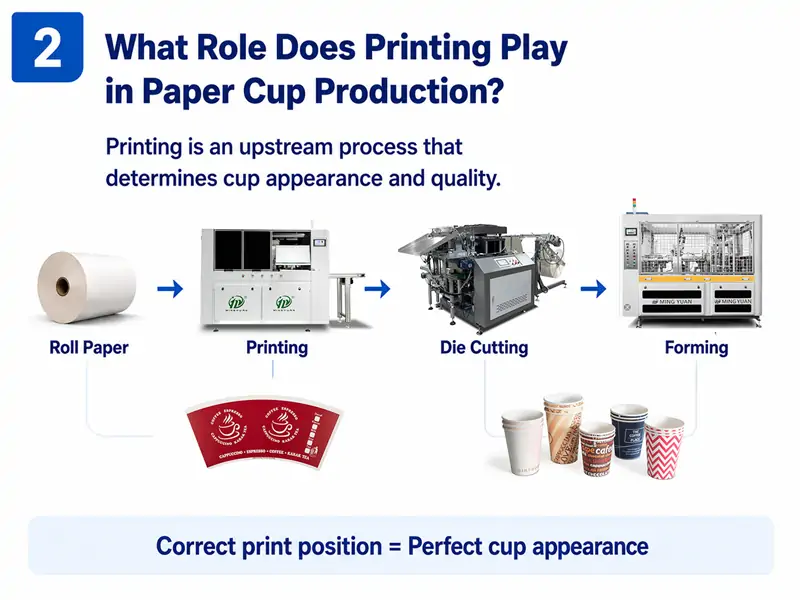
Printing is an upstream process. It happens before the paper is die cut into fan shapes and before the fans enter the forming machine. The printed layout must match the cup fan drawing, side seam, visible area, cup size, and forming direction. If the print position is wrong, even a good forming machine cannot fix the finished cup appearance.
Coated paper roll or sheet -> printing -> drying or curing control -> die cutting -> fan inspection -> cup forming -> counting and packing
This is why printing cannot be planned separately from die cutting and forming. The buyer should confirm artwork, material width, color requirement, cutting layout, and cup mold compatibility before deciding whether to print in-house.
Outsource Printing or Print In-House?
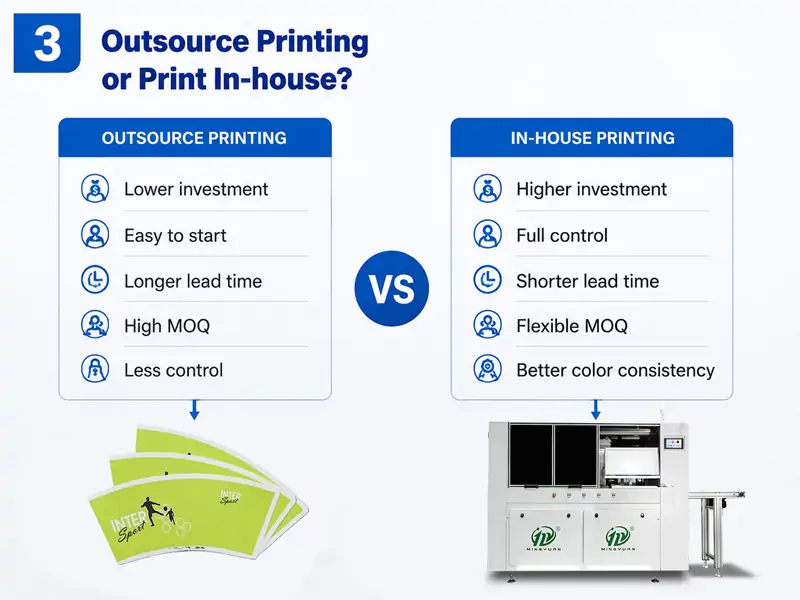
| Decision Factor | Outsource Printed Fans | Print In-House |
|---|---|---|
| Initial investment | Lower and easier for startup factories | Higher due to machine, plates, ink, tools, training, and workspace |
| Lead time control | Depends on supplier schedule and minimum quantity | Better when orders repeat and scheduling is disciplined |
| Design flexibility | Limited by supplier setup and MOQ | Stronger for frequent custom designs |
| Quality responsibility | Supplier controls print and cutting quality | Factory must manage color, registration, drying, waste, and inspection |
| Best fit | Unstable demand, few designs, or early-stage factories | Stable printed volume and repeat branded orders |
How to Calculate the Real Printing Cost Difference
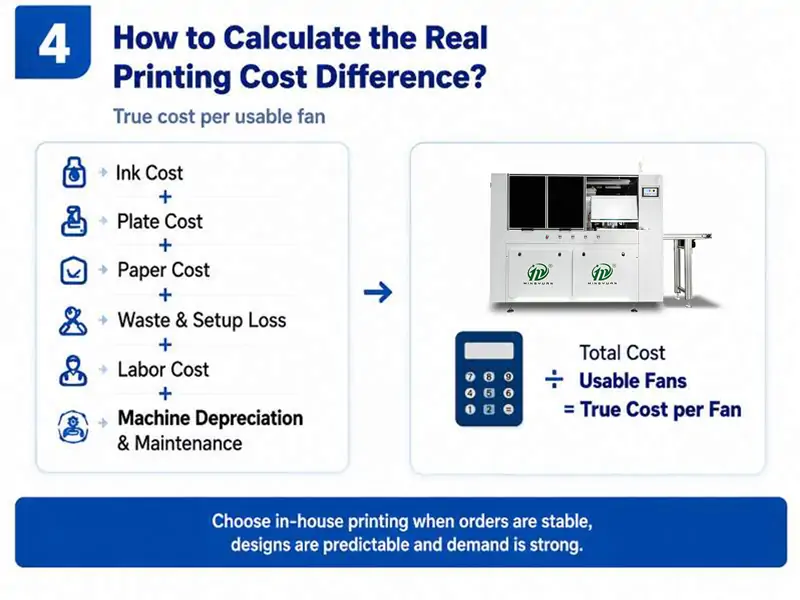
The printed fan price from a supplier should be compared with the real internal cost of printing, not only the price of blank coated paper. In-house printing includes ink, plates, setup waste, operator labor, power, maintenance, quality checks, rejected sheets, and allocated machine cost.
In-house printed usable material cost
Blank coated paper + ink + plate and setup cost + operator labor + power + maintenance allowance + print waste + allocated machine cost
The useful comparison is cost per usable printed fan that reaches forming. If a printed sheet is rejected before die cutting or if finished fans are unusable because artwork position is wrong, the apparent printing saving disappears.
Payback check
Printing equipment investment ÷ monthly net saving from confirmed in-house printed orders
Order Signals That Justify In-House Printing
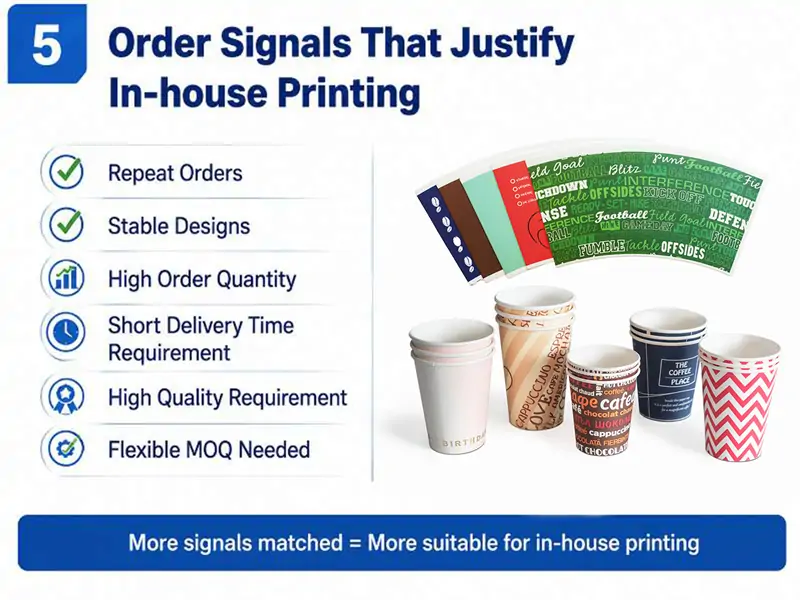
- Customers repeatedly order branded coffee cups, tea cups, or takeaway cups.
- Current printed fan suppliers require high minimum quantities that create dead stock.
- Long outsourced printing lead time causes lost urgent orders.
- The factory has enough repeat designs to use the printing machine regularly.
- Operators can be trained to control registration, color, cleaning, and waste.
- The financial comparison remains positive under conservative utilization.
If the factory only receives occasional custom printed orders, outsourcing usually protects cash better than buying printing equipment too early.
How Printing Connects With Die Cutting and Forming
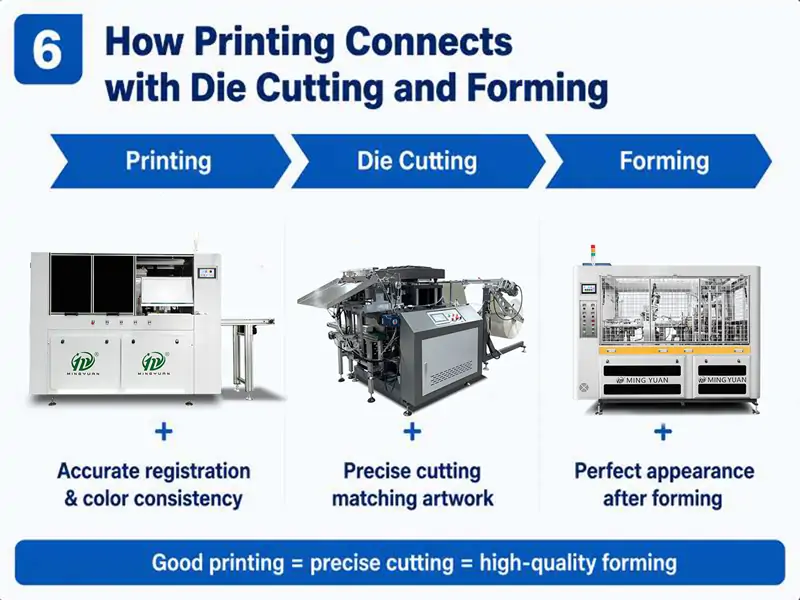
Printing must be coordinated with the die cutting layout. The fan shape, artwork position, side seam allowance, cup rim area, and bottom area must match the final cup. Poor coordination can create beautiful printed paper that forms into a cup with a misplaced logo or a visible design break.
| Stage | Control Point | Buyer Benefit |
|---|---|---|
| Artwork | Correct fan template and visible area | Fewer sample revisions and faster approval |
| Printing | Color, registration, drying, and coating compatibility | Stable appearance across repeat orders |
| Die cutting | Cutting position and fan size | Better forming stability and correct logo position |
| Forming | Side seam, cup shape, and final appearance | Saleable branded cups with fewer complaints |
Factories that want a complete upstream system should evaluate the paper cup printing machine together with die cutting, fan storage, and forming requirements.
Inventory and Design Risks Buyers Should Control
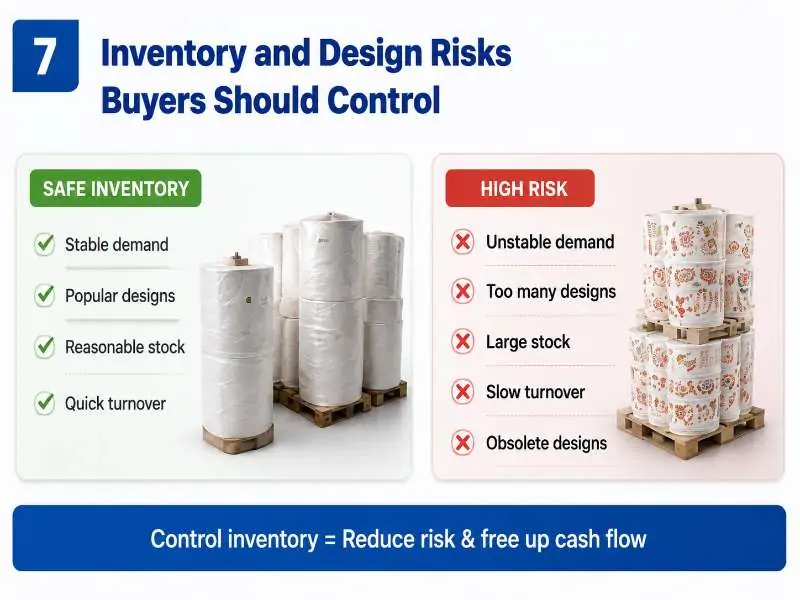
Printed material is less flexible than blank coated paper. If a customer changes a logo, cancels an order, or changes cup size, printed fans may become difficult to reuse. This risk is one reason custom printed cup orders need clear approval and payment rules.
- Require approved artwork before production.
- Set minimum order quantities for customer-specific designs.
- Use deposits for custom printed orders when possible.
- Keep blank coated paper stock flexible across several designs.
- Separate printed fan inventory by customer, design, cup size, and revision date.
How Sample Approval Protects Printed Cup Profit
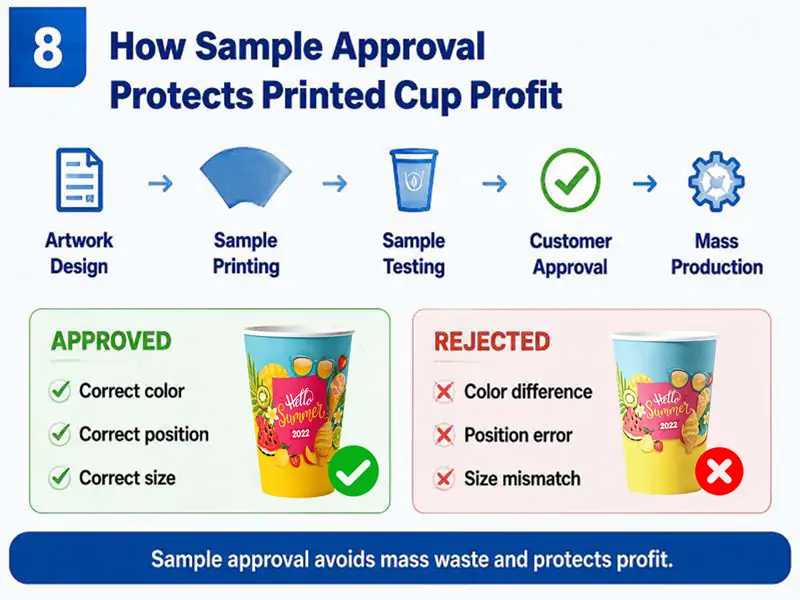
Printed paper cup production has a different risk profile from plain cup production. A plain cup can often be sold to several buyers if the size and material are common. A custom printed cup may belong to only one customer. If the color, logo position, cup size, or packing details are not approved before production, the factory may hold inventory that cannot be resold.
A practical sample approval process should confirm more than artwork. The buyer should check the final formed cup, not only the flat printed paper. A design that looks correct on a flat sheet may shift after die cutting, side sealing, curling, and stacking. This is especially important for logos near the side seam, curved text, large background blocks, and designs that must face a specific direction in the carton.
| Approval Item | Why It Matters |
|---|---|
| Artwork and revision number | Prevents producing an old logo, old color, or outdated promotion. |
| Formed cup sample | Confirms that print position still looks correct after die cutting and forming. |
| Bag and carton quantity | Avoids repacking work and delivery disputes after production. |
| Deposit or written order | Reduces the cash risk of customer-specific printed material. |
For custom printed paper cups, sample approval is not only a quality step; it is a financial control step.
Factories that plan in-house printing should build these approval rules before buying equipment. The machine can shorten lead time, but it cannot protect profit if orders are accepted without clear design confirmation, minimum quantity, payment terms, and material responsibility.
Which Buyer Type Should Add Printing First?
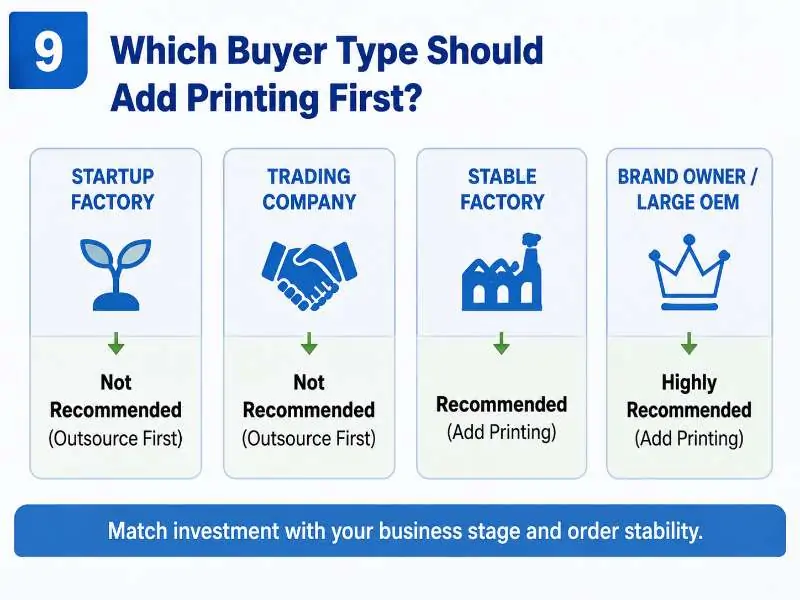
| Buyer Type | Recommended Strategy | Main Risk |
|---|---|---|
| Startup cup factory | Usually outsource printed fans first | Buying too much upstream equipment before orders stabilize |
| Coffee cup supplier | Consider in-house printing after repeated branded orders appear | Too many small custom designs with weak margins |
| Existing paper cup factory | Evaluate printing if supplier lead time limits sales | Underestimating staff and quality-control needs |
| Packaging distributor | Use customer purchase data before investing | Confusing occasional printed inquiries with stable volume |
Common Investment Mistakes
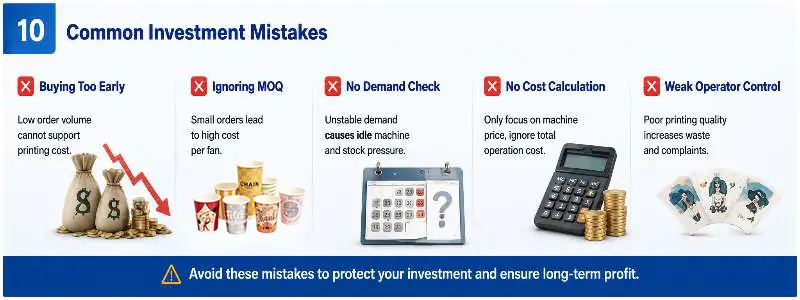
- Buying printing equipment before confirming repeat printed cup volume.
- Ignoring die cutting and forming compatibility when planning artwork.
- Calculating savings without setup waste, plates, labor, and rejected material.
- Accepting custom designs without deposits or clear minimum quantities.
- Assuming every operator can control color and registration without training.
- Letting printed inventory grow faster than confirmed orders.
Pre-Purchase Checklist
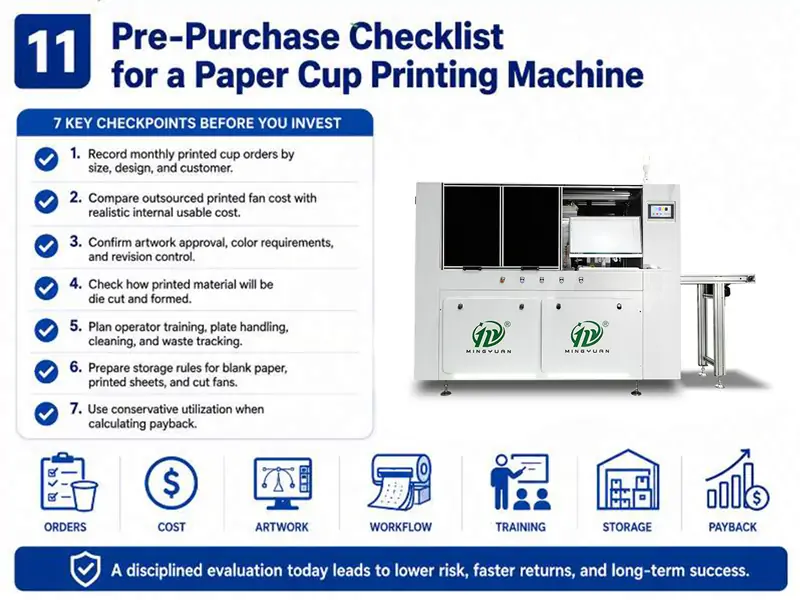
- Record monthly printed cup orders by size, design, and customer.
- Compare outsourced printed fan cost with realistic internal usable cost.
- Confirm artwork approval, color requirements, and revision control.
- Check how printed material will be die cut and formed.
- Plan operator training, plate handling, cleaning, and waste tracking.
- Prepare storage rules for blank paper, printed sheets, and cut fans.
- Use conservative utilization when calculating payback.
Frequently Asked Questions
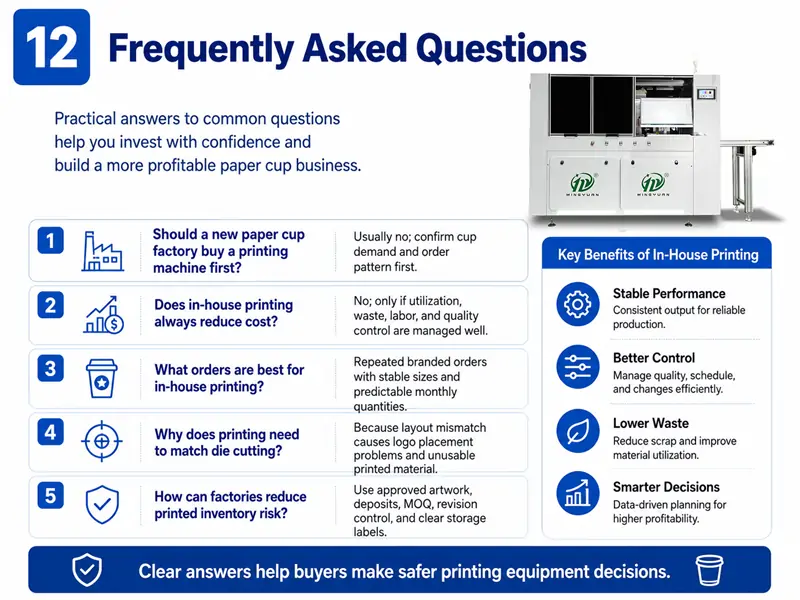
Should a new paper cup factory buy a printing machine first?
Usually no. A startup should first confirm cup demand, forming stability, and customer order patterns. Printing can be added when repeated branded orders justify the extra process.
Does in-house printing always reduce cost?
No. Internal printing can reduce lead time and supplier dependence, but only if utilization, setup waste, labor, and quality control are managed well.
What orders are best for in-house printing?
Repeated branded orders with stable sizes and predictable monthly quantities are more suitable than occasional short-run custom designs.
Why does printing need to match die cutting?
The printed design must appear correctly after the sheet is cut into fans and formed into cups. Layout mismatch can cause logo placement problems and unusable printed material.
How can factories reduce printed inventory risk?
Use approved artwork, deposits, minimum quantities, revision control, and clear storage labels. Keep blank coated paper flexible whenever possible.
The Bottom Line
A paper cup printing machine is valuable when printed cup orders are stable enough to justify equipment, operators, setup waste, quality control, and inventory management. It is less suitable when custom printing demand is still occasional or uncertain.
For many buyers, the real decision is not whether printing looks attractive, but whether it improves confirmed order flow. If in-house printing helps the factory quote faster, protect delivery time, and win repeat branded orders without creating slow-moving inventory, the investment has a stronger business case.
The safest approach is to outsource first, measure repeat printed demand, then add in-house printing when the numbers prove that control and savings are worth the added complexity.
Before investing, organize printed cup orders by customer, design, size, monthly quantity, and lead time. Then compare outsourced cost with internal usable printed fan cost under conservative utilization.