 English
 Pусский
 Français
 Español
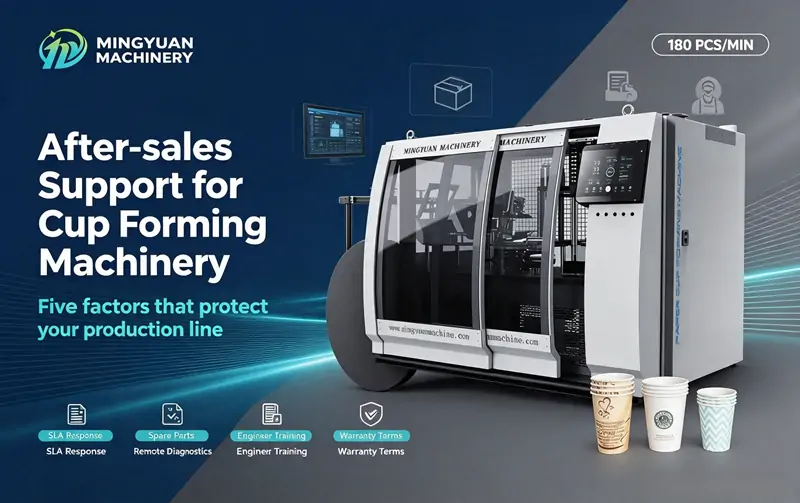
After-sales support is often the dividing line between a productive investment and a machine that quietly drains your budget. In the cup forming sector, where output speed and consistency directly dictate profitability, a supplier's commitment to post-installation service can matter more than the initial price tag.
Yet many buyers find it difficult to assess that commitment before purchase. Sales conversations naturally focus on capacity, material compatibility, and cycle times. Service is discussed in warm, general terms—"We'll always be there for you"—without the concrete details that actually protect your production line.
This guide breaks down what reliable after-sales support should look like for cup forming machinery, and the steps you can take to verify it before signing a contract.
Where After-Sales Support Usually Breaks Down
The most common frustrations come from structural gaps, not malice. Understanding these patterns helps you ask the right questions early.
Promises without process: A sales representative may offer "24/7 support," but the engineering team works a single shift and lacks a formal escalation path.
Parts availability: A manufacturer can dispatch spares quickly from its home warehouse, but if nothing is held locally or in a bonded zone, your lead time might still stretch to two or three weeks.
Ambiguous warranty terms: Exclusions for consumables, operator error, or power fluctuations can leave you responsible for repairs you thought were covered.
Limited remote capability: If the control system doesn't allow secure remote diagnostics, even a simple sensor fault can require an expensive on-site visit.
These are not hypothetical risks. They occur regularly when after-sales is treated as an add-on rather than a designed part of the equipment package.
Five Factors to Evaluate Before You Buy
Instead of relying on promises, audit a supplier's support infrastructure. The following five factors give you a concrete checklist.
1. Documented Response Commitments
Ask the supplier to include a Service Level Agreement (SLA) in the commercial proposal. A credible SLA should specify acknowledgement time for a service request (e.g., within 4 working hours), maximum time to dispatch an engineer or initiate remote diagnosis, and resolution targets for critical, major, and minor issues.
For example, some suppliers of cup forming systems now incorporate remote desktop access to the PLC, allowing a technician to troubleshoot in real time. When paired with an SLA, this can dramatically shorten downtime.
2. Spare Parts: Inventory, Not Just Catalogues
Having a long list of "available parts" means nothing if the one you need sits 8,000 miles away. Clarify which parts are recommended for on-site stock—blades, heaters, sensors, sealing elements—and whether the supplier operates a regional logistics hub or works with couriers that offer 3–5 day delivery for most components.
If critical parts can be pre-positioned based on your model, this is particularly relevant for high-speed lines. When investing in a paper cup machine, ask specifically about wear-part kits that match your target output level.
3. Remote Diagnostic Infrastructure
Modern cup forming equipment increasingly includes networked controllers. Ask whether the machine supports secure VPN access for remote troubleshooting, real-time monitoring of key parameters such as temperature, motor current, and cycle count, and automatic alert notifications for deviations.
This capability can resolve over a third of typical service calls without any physical visit, saving both time and travel costs. It also provides a data trail that helps prevent recurring issues.
4. Engineer Training and Availability
When an on-site visit is unavoidable, you need to know who is coming. Verify whether service engineers are factory-trained on your specific machine series, the typical travel time for in-warranty and out-of-warranty calls, and whether the supplier provides technical documentation in your preferred language.
These details are often overlooked until a multilingual misunderstanding delays a repair by days.
5. Warranty That Covers Real-World Use
Move beyond the "12-month warranty" headline. Request a written list of what is—and is not—covered. Pay particular attention to coverage for structural welds and main drive components, conditions that void the warranty such as using non-approved consumables, and whether the warranty period starts from shipment, delivery, or installation sign-off.
Some agreements start the clock on the day the machine leaves the factory. If it then spends six weeks in transit and installation, your effective protection shrinks significantly. Before finalizing your purchase, review actual installation timelines and negotiate a warranty that starts from commissioning, not factory shipment.
Building Your Own Support Scorecard
The most effective way to use these factors is to create a simple scorecard before supplier meetings. List the five areas—SLA clarity, parts availability, remote access, engineer readiness, warranty terms—and assign a weight based on your operation's sensitivity to downtime. Then score each supplier you are considering.
This turns a subjective feeling about "good service" into a comparable metric.
Remember that after-sales support is not a department; it's a system. A responsive phone operator is valuable, but meaningless without a parts logistics chain and a properly trained engineering team behind them.
If you need a deeper benchmark for comparing configurations—including how different models affect long-term service requirements—you may review the full specifications before making a decision.