 English
 Pусский
 Français
 Español
Speed. It’s the first number printed on every specification sheet, the one sales conversations fixate on, and – unfortunately – the most misunderstood figure in the entire buying process. A machine rated at 150 pieces per minute might only deliver 110 when running the cup size and paper weight your market demands. Other times, it hits 150 but with a rejection rate that eats away any gain in line speed. Before committing to a high-speed paper cup maker, there are at least five other specifications that deserve equal, if not more, attention. Let’s walk through them.
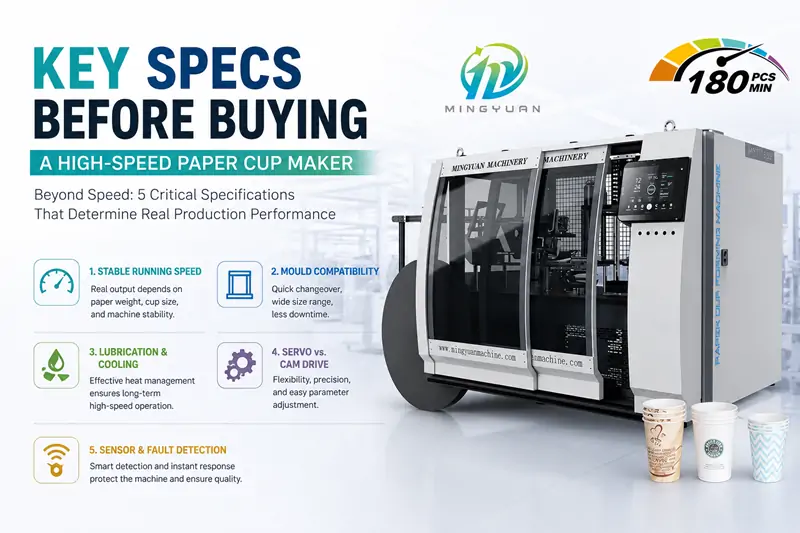
1. Rated Speed vs. Stable Running Speed – and What Drags Them Apart
The headline number on a data sheet is almost always the mechanical maximum – the cycle rate the indexing system can achieve under ideal conditions with thin paper, a single cup size, and a well-broken-in mould set. In everyday production, three factors pull that number down: paper weight, cup height, and bottom diameter.
Heavier paper stock (above 280 gsm) requires slightly longer dwell time in the sealing and bottom-knurling stations to transfer heat effectively. Taller cups, especially those above 120 mm in height, increase the distance the forming mandrels must travel, stretching the cycle. A specification worth asking about is the machine’s stable running speed range for the specific cup size and grammage you intend to produce. A manufacturer who can supply a speed curve – output plotted against paper weight and cup size – is giving you a tool to forecast real capacity, not just a lab number.
2. Mould Compatibility and Changeover Logic
A forming machine that makes one size beautifully but takes an entire shift to swap to another isn’t a high-speed solution – it’s a bottleneck. The mechanical design of the mould clamping system dictates how quickly you can change sizes. Some machines use a split-mould design that lets you replace only the top forming die or the bottom knurling insert without disturbing the entire stack, reducing changeover time to under 30 minutes for a half-set mould change.
Pay attention to the range of bottom diameters the machine’s frame accepts. If you plan to serve a market that demands both 4 oz espresso cups and 16 oz takeaway cups, you need a frame designed for a wider mould excursion. A machine rated for 4–16 oz cups will often handle that range, but the changeover complexity grows significantly at the extremes. Look for tool-free clamping or quick-release mechanisms in the curling and bottom-punch stations – those are the ones that consume the most time during a size swap. Specifications like these matter far more than a few extra pieces per minute when your production schedule shifts daily.
When evaluating how mould interchangeability impacts your total cost of ownership, it’s helpful to review the design of a paper cup machine that uses a split-mould architecture and supports multiple half-set moulds per frame, which directly reduces changeover downtime for multi-size production runs. (Note: This is the only instance where the exact match core word appears as anchor text, as permitted.)
3. Lubrication and Cooling Architecture
High-speed forming generates heat – at the sealing horn, the curling station, and throughout the gear train. How the machine manages that heat determines whether it can run three shifts or starts breaking down halfway through the second.
A circulating oil lubrication system with an integrated filter and cooler keeps gearbox temperatures stable. A specification worth checking: the oil circuit should reach every cam follower and indexing drive bearing, not just splash-lubricate from the bottom. On the mould side, forced air cooling through dedicated channels in the forming dies prevents the scorching of PE-coated paper and extends the life of the non-stick coating on the curling dies. If you intend to run PLA-lined paper, which requires higher forming temperatures (around 180–220°C), cooling efficiency becomes even more critical. Ask whether the mould set includes air holes sized specifically for your cup diameter; generic designs often under-cool the bottom die, leading to delamination.
4. Servo-Driven vs. Mechanical Cam Drive
This debate comes down to flexibility versus simplicity. A fully mechanical cam-driven machine is robust, with decades of proven reliability, but changing the timing between stations requires swapping physical cams – a process measured in hours. A servo-driven machine, where each forming station (paper feeding, bottom punching, curling, rimming) has an independent motor, lets you adjust timing parameters from the touch screen in minutes. That means you can fine-tune dwell time for a tricky paper batch or a new PLA grade without mechanical rework.
The trade-off is complexity: more servo motors mean more drives, more wiring, and a steeper learning curve for maintenance teams. A hybrid approach – using servo motors for the bottom-punch and curling stations while keeping the main indexing drum cam-driven – often strikes a practical balance for plants running a stable product mix. The specification you need: number and wattage of servo motors per function, and whether the HMI stores recipe settings for different cup sizes so operators can load a proven parameter set with a single tap.
5. Sensor Architecture and Fault Detection
Paper misfeeds, missing bottoms, and ultrasonic welding faults happen. What separates a high-speed machine from an average one is how quickly the control system detects a problem and reacts. Look for multiple photoelectric sensors along the paper fan feed path – at least one before the forming station to verify paper presence and one after cup ejection to confirm a complete cup has left the transfer mechanism. A well-designed system stops the machine within one cycle when a fault occurs, preventing the jam from cascading into the next station and damaging the moulds.
The ultrasonic sealing system should include an amplitude and frequency monitoring function on the HMI. A drifting resonant frequency is an early warning of a worn converter or a cracked horn, long before the seal strength starts to degrade. For users considering machines with more advanced fault-handling logic, it can be useful to explore the detailed specifications of high-speed forming equipment that include PLC-driven multi-sensor arrays and automatic cycle-stop capabilities.
The Specs That Don’t Appear on Brochures
A few final points worth asking about, even if they never make it onto a glossy flyer: the recommended paper grammage range for stable feeding (not just mechanical capability, but what the suction cups and vacuum generator can consistently handle); the actual power consumption at stable running speed, not just total installed power; and the availability of remote diagnostic access. Many troubleshooting hours are lost because a technician must physically travel to a machine, when a simple PLC log dump could have identified the fault remotely.
Making the Right Choice for Your Production Environment
Every specification on a data sheet interacts with the others. A high maximum speed is useless without a cooling system that sustains it, a mould change design that lets you use it across multiple cup sizes, and a sensor network that protects the tooling when something goes wrong. Before you compare numbers in a table, define your typical production scenario: the two or three cup sizes that will run 80% of the time, the grammage of the paper your customers accept, and the number of weekly size changeovers. Then, test the specification against that scenario.
If you are currently evaluating different configurations and want to see how Mingyuan’s high-speed cup forming solutions address these five specification areas – including split-mould design, closed-loop lubrication, and servo-hybrid drive options – you can request detailed technical documentation through the product page. Understanding what truly drives performance before you sign a purchase order helps ensure your investment matches your production reality.