 English
 Pусский
 Français
 Español
In disposable cup manufacturing, two production lines with similar specifications can deliver completely different long-term results.
One may maintain stable output for years, while another gradually develops issues such as inconsistent sealing, transmission wear, and rising maintenance costs.
In many cases, the difference comes from the machine’s motion control system rather than operator skill alone.
Today, manufacturers entering the disposable packaging market often face the same question: should they invest in a traditional mechanical transmission structure or move toward a fully servo-driven configuration?
The answer depends less on “which is newer” and more on production goals, labour conditions, maintenance capabilities, and long-term scaling plans.
Why This Decision Matters More Than Ever
The global demand for disposable beverage containers continues to rise, especially in the takeaway coffee, cold drinks, and food delivery sectors. According to data from the Smithers packaging industry reports, automation and energy efficiency are becoming the top purchasing priorities for converting equipment manufacturers.
At the same time, labour costs and maintenance complexity are increasing in many production regions. A machine that seemed “cheap” initially may become expensive after repeated downtime and spare part replacement.
That’s why many buyers now evaluate forming systems based on:
- Stability during continuous production
- Energy consumption per thousand cups
- Ease of operator training
- Noise and vibration levels
- Maintenance frequency
- Flexibility for different cup sizes
If you're currently evaluating different forming technologies, it helps to first understand how the two systems fundamentally differ.
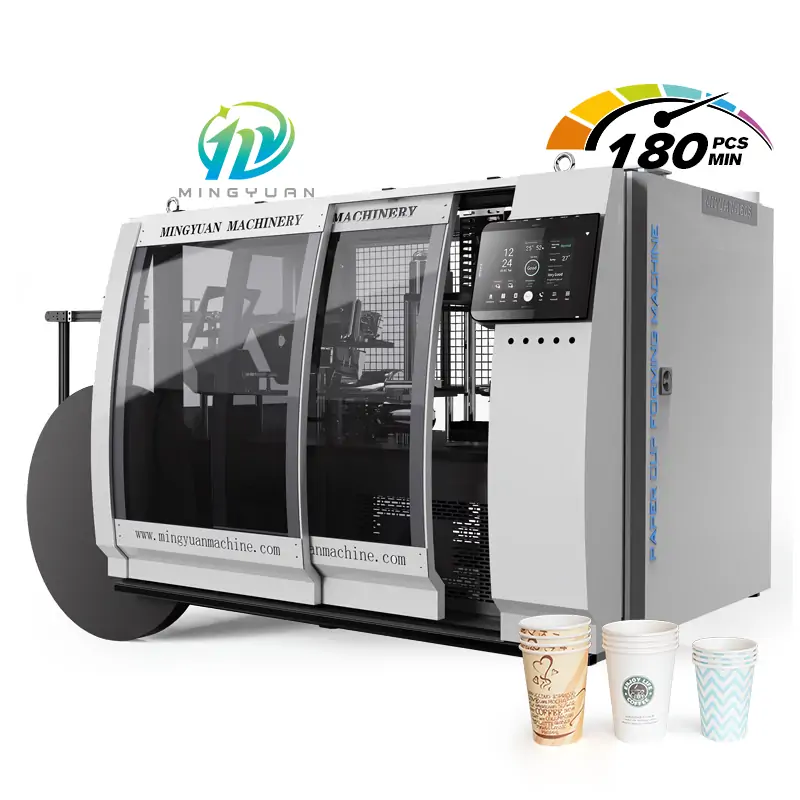
For example, many manufacturers compare integrated automation layouts before making a final investment decision. You can use high-speed cup production system layouts to better understand how different transmission systems are arranged in real production environments.
Mechanical Systems: Proven but Maintenance-Heavy
Mechanical transmission systems rely on cams, chains, gears, and indexing structures to coordinate machine movements.
For decades, this approach dominated cup production because it was reliable, relatively affordable, and easier to repair in regions where advanced electrical technicians were unavailable.
Advantages of Mechanical Structures
1. Lower Initial Investment
Mechanical models are often less expensive upfront, making them attractive for startups or smaller workshops.
2. Familiar Maintenance Logic
Technicians in traditional manufacturing environments are usually experienced with replacing bearings, adjusting chains, and calibrating cams.
3. Stable for Standardised Production
If a factory only produces one or two common cup sizes continuously, mechanical systems can maintain acceptable consistency.
The Hidden Costs Behind Mechanical Operation
However, mechanical structures also introduce several long-term operational challenges.
Wear and Tear Accumulate Quickly
High-speed movement generates friction across multiple components. Over time:
- Cam profiles wear down
- Chains loosen
- Timing accuracy shifts
- Lubrication requirements increase
Even small alignment errors can affect sealing quality or cup wall consistency.
Noise and Vibration Become Operational Issues
Factories running older transmission systems often report higher vibration levels, especially during 24-hour production cycles. Besides operator discomfort, vibration can shorten the lifespan of adjacent components.
Changeovers Take Longer
Switching between cup sizes usually requires more manual adjustment points, increasing downtime during production transitions.
Some production managers, therefore, prefer newer automated solutions designed for rapid format switching and digital parameter control. You can explore examples of flexible cup size conversion solutions commonly used in multi-product production facilities.
Full-Servo Systems: Precision Through Digital Control
Servo-driven systems replace many traditional mechanical synchronisation parts with electronically controlled motors.
Instead of relying entirely on cams and fixed mechanical timing, servo motors coordinate movement dynamically through programmable control systems.
Where Full-Servo Technology Excels
1. Higher Precision
Servo systems allow more accurate motion control during:
- Bottom sealing
- Curling
- Side sealing
- Feeding synchronization
This becomes especially important when producing thin-wall cups or lightweight, eco-friendly materials.
2. Faster Size Changeovers
Operators can often adjust production parameters digitally instead of manually recalibrating multiple transmission points.
In factories producing seasonal or customised orders, this significantly reduces downtime.
3. Lower Long-Term Maintenance
Because there are fewer continuously contacting mechanical components:
- Lubrication needs decrease
- Mechanical wear reduces
- Noise levels improve
- Maintenance intervals become longer
4. Better Energy Efficiency
Servo motors only consume power according to movement demand, unlike continuously rotating mechanical systems.
According to industrial automation studies published by the International Energy Agency, optimised servo systems can improve industrial motor efficiency substantially in repetitive-motion manufacturing environments.
Side-by-Side Comparison
| Factor | Mechanical Structure | Full-Servo Structure |
| Initial Cost | Lower | Higher |
| Maintenance Frequency | Higher | Lower |
| Production Precision | Moderate | High |
| Noise Level | Higher | Lower |
| Energy Efficiency | Standard | Better |
| Changeover Speed | Slower | Faster |
| Operator Dependency | Higher | Lower |
| Long-Term Scalability | Limited | Strong |
Which One Fits Your Factory?
Mechanical Systems May Be Better If:
- Your budget is highly constrained
- You produce only one standard cup type
- Skilled electrical technicians are unavailable locally
- Your production volume is relatively stable
Full-Servo Systems Make More Sense If:
- You plan to scale production
- You frequently change cup sizes
- You prioritise energy efficiency
- Labour costs are rising
- You need higher consistency for export-quality production
In reality, many medium-sized factories now choose hybrid approaches — combining mechanical durability in certain stations with servo control in critical forming sections.
Manufacturers researching scalable automation platforms often compare modular production concepts before upgrading existing lines. You can check several servo-driven cup manufacturing configurations here to understand how different automation levels are integrated.
What Experienced Buyers Usually Ask Before Purchasing
Experienced production managers rarely focus only on speed specifications.
Instead, they ask questions like:
- How difficult is spare part sourcing?
- Can local technicians handle troubleshooting?
- What is the average downtime per month?
- How stable is bottom sealing at high speed?
- Does the system support lightweight paper materials?
- How fast can operators learn the interface?
These practical questions often determine profitability more than maximum output numbers on a brochure.
Final Thoughts
There is no universal “best” forming system.
A mechanical structure can still deliver excellent value for stable, high-volume production environments with predictable output requirements.
But for factories targeting flexibility, automation, energy savings, and long-term operational stability, servo-driven technology is increasingly becoming the preferred direction.
The smartest investment is usually the one aligned with your production strategy — not simply the newest technology available.
If you want a closer look at modern automated cup-forming solutions, production layouts, and configurable forming systems, you can also review Mingyuan’s automated disposable cup production lines for additional technical reference.
References & Disclaimer
- Packaging market automation insights from Smithers industry publications
- Industrial motor efficiency guidance from the International Energy Agency
- This article is intended for informational and equipment selection reference purposes only. Actual production performance may vary depending on material quality, operator training, maintenance standards, and factory conditions.